Categories
Uncategorized

A Museum of Mathematics

Mathematics illuminates the patterns that abound in our world. The Math Factory strives to enhance public understanding and perception of mathematics. Its dynamic exhibits and programs will stimulate inquiry, spark curiosity, and reveal the wonders of mathematics. The museum’s activities will lead a broad and diverse audience to understand the evolving, creative, human, and aesthetic nature of mathematics.

The above is the mission statement of The Math Factory, an organization headed by former Renaissance Technologies analyst (and CTY alumnus) Glen Whitney that aspires to build a national museum of mathematics in New York. The effort is well underway–the organization has raised $4M to date, attracted an impressive group of trustees and advisors, and has obtained quite a bit of enthusiastic press coverage. No wonder–the Math Midway it exhibited at the World Science Festival this past June was a wild success. I’d gone there to offer moral support, only to find that I was lucky to get close enough to see the exhibits!

Last night, I was fortunate enough to attend a gala at the Urban Academy and actually play with the exhibits–from riding a tricycle with square wheels to walking through a maze without making left turns. It was a blast! And, while I’ll admit to being favorably predisposed towards math, the exhibits hardly required such a predisposition–any more than the Exploratorium in San Francisco requires a predisposition towards science. Rather, experiences like these create excitement, overcoming the negative preconceptions that too many children (and adults!) have about this subjects.

While I suspect that many Noisy Channel readers are already sold on both the enjoyment and core societal value of mathematics, I encourage you to think about how much better a world we would have if this appreciation were more widely shared. For those who have to think about large numbers just to manage their assets, I encourage you to think of The Math Factory as worthy of your philanthropy. I encourage everyone to contribute your ideas and endorsements to this visionary effort.
Categories
Uncategorized

Ethics of Blogging: Webcast Now Available

Thanks to Robin Fray Carey for posting the webcast of the Ethics of Blogging panel on the Social Media Today site. You can also catch the tweet stream at #SMTWebcast while it’s still indexed.

Categories
Uncategorized

Ethics of Blogging Panel Today

Just a reminder that I’m participating in an online panel today (at 1pm EST) to discuss the Ethics of Blogging.

Maggie Fox, founder and CEO of Social Media Group, will moderate a panel composed of Augie Ray, who blogs at Experience: The Blog) and is Managing Director of Experiential Marketing at interactive and social media agency Fullhouse; John Jantsch, who blogs at Duct Tape Marketing and is a marketing and digital technology coach; and yours truly. It’s free to attend; just register here.

Categories
Uncategorized

Goby Goes Deep

At  the first HCIR workshop in 2007, Michael Stonebraker stood up in the middle of an open discussion session and told all assembled that we needed to be thinking about the deep web.

I don’t know how much the audience took heed of his call, but he certainly followed his own advice. He and Endeca alum Mark Watkins just launched Goby, a vertical search engine that exhorts you to “create your own adventure”.  It’s fun–a sort of exploratory search for explorers. And it uses a deep web crawl to populate its index with semi-structured data.

Anyway, try it out! I’ve been in the private beta, but haven’t had the chance to see what they’ve been up to in the final stretch leading to the launch. You can also read more on Search Engine Land or CNET.

Categories
Uncategorized

Follow-Up Podcast for UIE Seminar on Faceted Search (Free!)

Last month, Pete Bell and I presented a virtual seminar on faceted search for Jared Spool’s User Interface Engineering (UIE). Whether or not you attended the seminar, you can listen to a free podcast in which we answer some of the questions we didn’t get to during the seminar. If you still have an unanswered question, I encourage you to ask it in the comment thread, and I’ll do my best to answer it!

Categories
Uncategorized

Live Tweeting from Transparent Text Symposium

As promised, I’ll blog about the two-day Transparent Text symposium when it’s over and I have a chance to collect and express my thoughts. But for now you can follow the live Twitter stream at #tt09.

Categories
Uncategorized

Project Gaydar: A Reminder That Privacy Isn’t Binary

There’s a nice article in the Boston Globe about “Project Gaydar“, a project to predict who is gay based on statistically analyzing their Facebook networks. They’ve only done ad hoc validation of their predictions, but claim that their results seem accurate. The involvement of distinguished MIT professor Hal Abelson (at least to the point where he’s quoted in the article) lends credibility to their effort.

I’m glad to finally see a real world example of the issues I blogged about last year in a post entitled “Privacy and Information Theory“:

The mainstream debates treat information privacy as binary. Even when people discuss gradations of privacy, they tend to think in terms of each particular disclosure (e.g., age, favorite flavor of ice cream) as binary. But, if we take an information-theoretic look at disclosure, we immediately see that this binary view of disclosure is illusory.

I’m curious to see if this project advances the conversation. At the very least, I’m gratified to see my abstract ramblings validated by a real-world example!

Categories
Uncategorized

Blogs I Read: The Haystack Blog

It’s been quite the week in tech business news, with Adobe acquiring Omniture, Google acquiring reCAPTCHA and being rumored (falsely) to acquire Brightcove, Facebook announcing that is has over 300M users and is cash-flow positive, and Twitter closing a new round of funding at a $1B valuation. Recession? What recession?

But sometimes I like to get away from all that and turn back to my roots inside the ivory tower. And that leads me to one of my favorite university blogs: the Haystack Blog.

The Haystack Blog is published by faculty and grad students in the MIT Computer Science and AI Lab (CSAIL)–specifically those in the Haystack group. Principal Investigator (and occasional dance instructor) David Karger is its most prolific blogger–you might have read some of his SIGIR 2009 posts or his debate with Stefano Mazzocchi about how to properly use RDF. But other people’s posts are just as interesting–check out the most recent post by Eirik Bakke about bridging the gap between spreadsheets and relational databases.

I wish that more universities and departments would encourage their faculty and students to blog. As Daniel Lemire has pointed out, it’s a great way for academic researchers to get their ideas out and build up their reputations and networks. He should know–he leads by example. Likewise, Haystack is setting a great example for university blogs, and is a credit to MIT and CSAIL.

Categories
Uncategorized

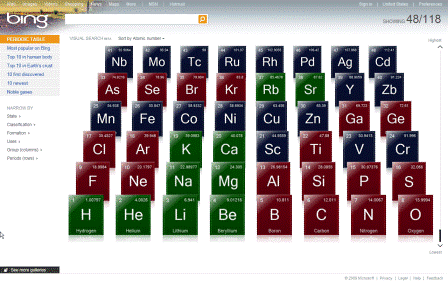
Bing Visual Search Beta

Periodic Table

Bing launched a Visual Search beta today that is fun to play with. The name may be a bit misleading–this isn’t an image search engine, let alone one that allows you to find images based on visual similarity. Rather, it’s a graphically intensive (don’t forget to install Silverlight!) way to explore a small data collection.

I agree with Elisabeth Osmeloski at Search Engine Land that the galleries included with this beta launch emphasize novelty over utility. Still, it’s nice to see a visual faceted search application for exploring the periodic table. And it’s an interesting example of micro-IR.

Categories
Uncategorized

Yahoo on Key Scientific Challenges in Search and Machine Learning

Like many folks, I’ve assumed that Yahoo’s partnership with Bing–assuming it is approved–offers the best chance of validating CEO Carol Bartz’s claim that Yahoo has “never been a search company“. She may not be able to change the past, but she certainly is making up for lost time. To be clear, I agree with her 100% that Yahoo should have accepted Microsoft’s $40B acquisition offer last year–in her words, “Sure, do you think I’m stupid?” But I’m still struggling to understand the rationale behind the deal Yahoo did accept.

In any case, Yahoo researchers haven’t stopped thinking about search. As Jeff Dalton reports, Yahoo recently issued a press release about its Key Scientific Challenges Summit. Jeff was kind enough to post Henry Feild’s notes about the presentations by Andrew Tomkins on search and by Sathiya Keerthi Selvaraj on machine learning. I’d love to hear more detail about how they perceive (and hope to address) the search challenges of optimizing task-aware relevance and measuring / predicting generating user engagement.

Regardless of Yahoo’s fate, I’m certainly glad that there are still people at Yahoo working on these big problems. I hope they find a way to develop solutions and bring those solutions to the users who need them.