Categories
Uncategorized

Wikipedia: Play The Ball, Not The Man

Today’s Freakonomics blog in the New York Times has a nice post entitled “By a Bunch of Nobodies: A Q&A With the Author of The Wikipedia Revolution“, in which Annika Mengisen interviews Wikipedia editor/administrator Andrew Lih.

Here’s an excerpt to whet your appetite:

Q: A while ago, Essjay, one of Wikipedia’s most prominent editors, lied about his background. What, if anything, did this do to Wikipedia’s credibility?

A: A prominent Wikipedia editor nicknamed Essjay claimed to be a tenured academic theologian who had to stay anonymous to protect him from trouble with his school. He was exposed in the end to not have any of those credentials, also lying to The New Yorker magazine about his background.

In this case, what’s interesting is despite his deception, the tens of thousands of edits he made and the community decisions he oversaw were, by all accounts, legitimate and useful. Even with much forensic investigation by community members who were skeptical about whether his fraudulent identity translated into fraudulent edits, they found nothing of note that was considered malfeasance.

This is perhaps why the biggest identity fraud in Wikipedia’s history has not created much of a crisis in community. From the very beginning, to borrow a sports analogy, Wikipedians “played the ball and not the man.”

Read the rest of the article here.
Categories
Uncategorized

Hunch Has Launched

For anyone who has been waiting to try Hunch (which really is a “decision engine“) but didn’t manage to snarf an invite, today is your lucky day: Hunch has launched. They’ve added some new features too–for example, they offer a faceted navigation interface that lets you bypass their ordering of the questions in the decision tree (e.g., for choosing a cocktail).

But be warned, the site may be a bit sluggish. They’re certainly getting bombarded with traffic from the blogosphere and Twitterverse!

Categories
Uncategorized

Attending Endeca Discover

Apologies for the unusual hiatus in posting–I’ve been attending Endeca Discover (an annual user conference) and haven’t managed to allocate time for blogging. I’ll make up for it by blogging about the conference tomorrow, when I’m back to what passes for normality. In the mean time, feel free to follow the conference on Twitter.

Categories
Uncategorized

Faceted Search Book: Now Available Online!

I’m delighted to report that my faceted search book is now available for online purchase at the Morgan & Claypool site! The printed version should be going out shortly (you can pre-order at Barnes & Noble or Amazon); the publisher assures me that there will be copies in time for SIGIR.

Categories
Uncategorized

Page’s Law? Try Wirth’s Law. Or Gates’s.

I hesitate to cite Valleywag as a news source, but I did read there that Sergey Brin is crediting fellow Google co-founder Larry Page with “Page’s Law“, the assertion that software gets twice as slow every 18 months, and thus outpaces Moore’s law.

Fortunately for Page, he is already assured of a solid entry in the history books. Because Page’s Law sounds suspiciously like Wirth’s law, pronounced by computer science titan Niklaus Wirth in 1995: “Software is getting slower more rapidly than hardware becomes faster.” In fact, the more precise version cited by Page is known as Gates’s law–though I don’t think Bill Gates want to take credit for it.

Categories
Uncategorized

2009 Enterprise Search Sourcebook

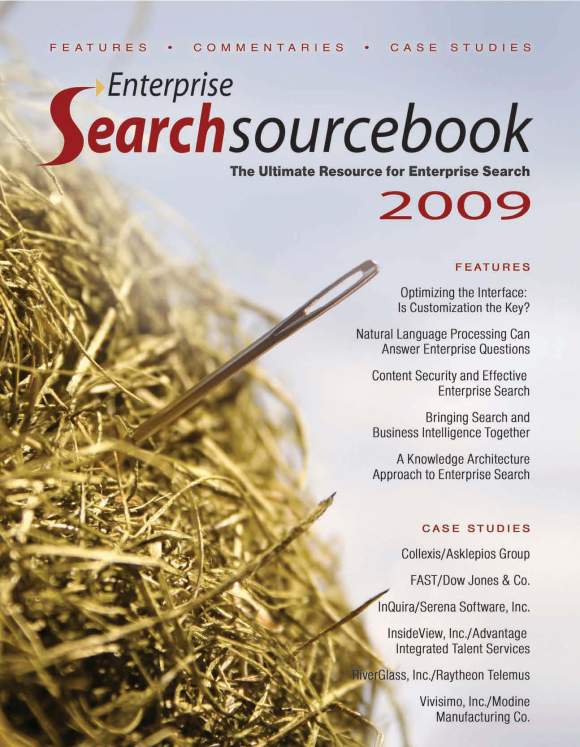
Enterprise Search Sourcebook 2009

I just noticed that the 2009 edition of the Enterprise Search Sourcebook is now available. Published by Information Today, it’s a nice way to survey the landscape. Of course, it goes without saying that you to take vendor claims with a grain of salt, but you have to start somewhere!

Of course, if you’re interested in learning more about enterprise search, be sure to check out the program for the SIGIR 2009 Industry Track–particularly the two panels: one comprised of leading industry analysts, and the other of senior technologists from the top three enterprise search vendors. Yes, I’m biased: I’m organizing it. 🙂

Categories
Uncategorized

NSF Report on Information Seeking Support Systems

Long-time readers may recall that I participated last year in an NSF Information Seeking Support Systems Workshop at the University of North Carolina, organized by Gary Marchionini and Ryen White. Some of the output of that workshop recently surfaced in a special issue of IEEE Computer. It’s a great issue, and I recommend it to those who have access to it either in print or online form (through the IEEE digital library).

But I know that many readers here do not have ready access to this material. Hence, I am delighted to announce that the workshop report is now available for free online. It’s a great introduction to the concerns occupying HCIR researchers.

Of course, if you’d like to meet some of these people face-to-face, I recommend you participate in HCIR ’09 this October. The deadline for position papers is August 24th. I hope to see you there!

Categories
Uncategorized

Book. Is. Done.

I couldn’t think of a better way to start a holiday weekend than by uploading the revised chapters of my faceted search book to the publisher. It was the first–and hopefully last–time that I have hand-edited pdf files (download a trial version of Acrobat here if you’re jealous). Barring some unforeseen event, the publishers will incorporate these last edits and then make the book available in hard-copy and electronic format in a few weeks!

I’d to thank everyone who helped me put the book together. I’m grateful to Candy Schwartz (the Co-Editor of Library & Information Science Research–how cool is that?) for her thorough feedback, as well to the the veritable army of voluntary reviewers who offered great suggestions to improve both the content and style of the book: Omar Alonso, Pete Bell, Amitava Biswas, Blade Kotelly, Sol Lederman (who also wrote a review based on the draft), Milan Merhar, Jennifer Novosad, XiaoGuang Qi, Brett Randall, Dusan Rnic, and Joshua Young. I hope I haven’t missed anyone!

And of course I am grateful for the support of my family and co-workers. Hopefully they will be glad to have me back among the ranks of the living.

Categories
Uncategorized

Data.gov

When I first heard that Vivek Kundra was on the short list to be the CTO of the United States, I was very excited about the possibility that he would implement information sharing at a national level like he had in DC. Today I’m happy to read that that the Federal CIO Council has launched Data.gov:

The purpose of Data.gov is to increase public access to high value, machine readable datasets generated by the Executive Branch of the Federal Government. Although the initial launch of Data.gov provides a limited portion of the rich variety of Federal datasets presently available, we invite you to actively participate in shaping the future of Data.gov by suggesting additional datasets and site enhancements to provide seamless access and use of your Federal data.

OK, so it’s still in beta, but I’m still gratified to see this step toward government transparency. And what a boon to information retrieval researchers looking for public data sets!

Categories
Uncategorized

Google Suggests…Ads

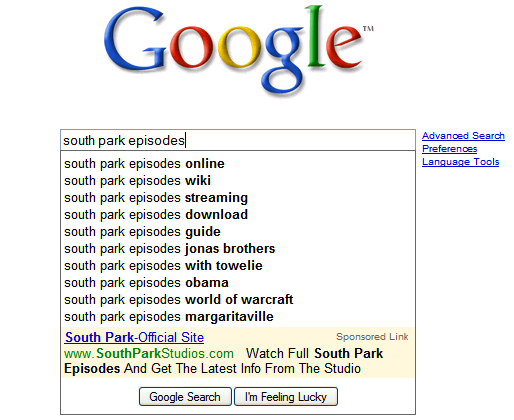
I haven’t seen this in my own browser yet, but MG Siegler at TechCrunch reports that Google Suggest has added advertising (see Google’s official post here). It also talks about personalization, but I’ve been seeing that for a while, so I don’t know that there’s anything new on that front.

In any case, here’s an example of a suggested ad, courtesy of TechCrunch:

I’m sure Firefox extensions like CustomizeGoogle will soon blog these ads, if they aren’t doing so already. Granted, I can hardly blame an ad-supported service for pushing more ads–and in this case the ad is actually a relevant result, independent of the fact that it’s sponsored. In fact, it’s the top-ranked organic search result for south park episodes. I imagine the feature will be considerably more annoying when the sponsored links are more typical ads, but probably not enough so to incite people to install ad blockers. Google seems to know how not to push people too far.