The list of accepted papers for HCIR ’08 is now posted on the workshop web site.As you can see an exciting collections of topics from an impressive collection of researchers. I hope to see some of you there next month.
Categories
High-Class Consultant.
The list of accepted papers for HCIR ’08 is now posted on the workshop web site.As you can see an exciting collections of topics from an impressive collection of researchers. I hope to see some of you there next month.
Google’s extended 10th birthday celebration has been accompanied by non-stop posts about Google, and I’ll confess to being part of that hype. Nonetheless, I thought Danny Sullivan’s recent post entitled “The Google Hive Mind” was one of the more informed analyses I’d read about Google of late. I don’t agree with it completely–in particular, I think it overstates Google’s openness. But still a worthwhile read.
Last week, I put out a call for help to clean up the Enterprise Search entry on Wikipedia. I decided to answer that call myself by moving the list of vendors and open source alternatives to a separate entry. I also cleaned up that list, eliminating the dubious classification scheme (which you can see on the pre-overhaul version of the Enterprise Search entry) and removing any vendors or open source software that are not notable enough to have Wikipedia entries.
Please take a look and make your own improvements! I see this overhaul as a first step. The resulting entry is a bit spartan, but at least it isn’t a disaster zone. Now we can think about fleshing out the definition(s) of enterprise search, which should be the focus of the entry.
An oldie but goodie that one of my colleagues at Endeca just reminded me of is the Periodic Table of Visualization Methods by Ralph Lengler and Martin Eppler at Visual-Literacy.org.

Click through the picture to the real page, which shows you an example each visualization when you hover over it in the table.
Interestingly, tag clouds don’t show up in the table? Is this because the authors hate them, or that tag clouds aren’t sufficiently graphical to qualify as a visualization? I know many people who despise tag clouds–and I used to be one of them. But I think they have their place, and I’ll return to the subject some time soon.
Vint Cerf published an Official Google Blog post about the next Internet in which he predicts that “that mobile devices will become a major component of the Internet,” that “video will become an interactive medium in which the choice of content and advertising will be under consumer control,” and “a box of washing machine soap will become part of a service as Internet-enabled washing machines are managed by Web-based services that can configure and activate your washing machine.” And, he concludes, “Google will be there, helping to make sense of it all, helping to organize and make everything accessible and useful.”
I hesitate to accuse someone as accomplished as Vint Cerf of lacking imagination, but I found his post uninspiring. As he should know better than most, mobile devices are already a major component of the Internet. Greater control of video would be nice, but how about greater control of the the world’s information that Google aspires to organize?
Perhaps posting on the Official Google Blog has a dampening effect. I’d like to believe that readers here at The Noisy Channel have wild imaginations and are uninhibited about exercising their creativity. Please use this space to do so!
After all, I do agree with Cerf about Alan Kay’s observation that the best way to predict the future is to invent it. Or, to quote him in full:
“Don’t worry about what anybody else is going to do… The best way to predict the future is to invent it. Really smart people with reasonable funding can do just about anything that doesn’t violate too many of Newton’s Laws!”
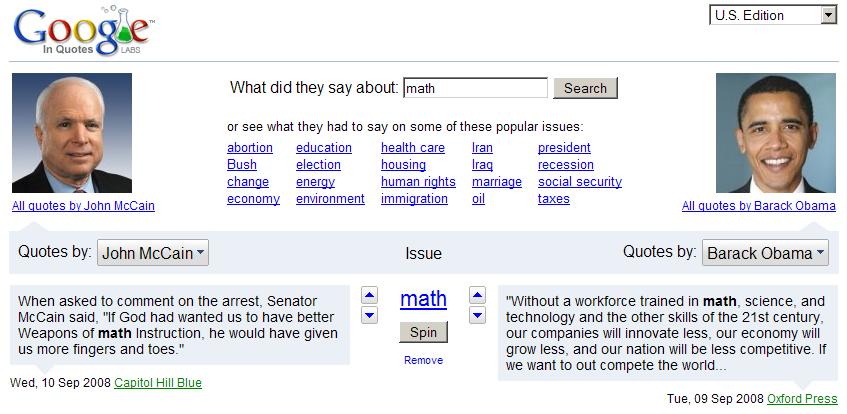
I was just checking out the latest Google Labs release: In Quotes. As described on their FAQ:
The “In Quotes” feature allows you to find quotes from stories linked to from Google News. These quotations are a valuable resource for understanding where people in the news stand on various issues. Much of the published reporting about people is based on the interpretation of a journalist. Direct quotes, on the other hand, are concrete units of information that describe how newsmakers represent themselves. Google News compiles these quotations from online news stories and sorts them into browsable groups based on who is being quoted.
Here’s a screenshot to give you a feeling for the application:
This reminds me of an idea I once discussed with Craig Newmark after hearing a talk by Miles Efron about using cocitation information to estimate the political orientation of web documents. I’d just heard of Craig’s interest in community journalism, and I thought he might be persuaded to consider a new way of automatically presenting news as neutral happenings (perhaps obtained through passage retrieval algorithms on the news stream) through a variety of ideological lenses. I’m not sure that very many people would be want to hear points of view in conflict with their own, but this is precisely what I feel people need to hear. The conversation never led to anything concrete, but it’s still something I muse about.
I’m experimenting with ways to weave this blog into the broader fabric of social media. Some of you may have noticed the ShareThis links on each post. I hope some of you are using them to share material you encounter here. Today, I added the Twitter Updater plug-in, so new posts will automatically trigger a Twitter update (you can follow me here).
I’m also playing with BackType–see my comments here. Eventually I’ll figure out a way to make The Noisy Channel a central location for reading all of my public rants.
Lynda Moulton wrote a post today entitled “Taxonomy, Yes, but for What?” in which she reminds us that taxonomies aren’t just for navigation. Here is an excerpt:
Taxonomies for navigation are but one purpose for them to be used in search….In more sophisticated applications of taxonomies, the thesaurus model of relationships becomes a necessity. When a search engine, has embedded algorithms that can interpret explicit term relationships, it indexes content according to a taxonomy and all its cross-references. Taxonomy here informs the index engine.
Whether we’re talking about taxonomies, ontologies, or faceted classification schemes, Moulton is right to note that we should also keep in mind the intent of these knowledge management structures before we get too caught up in the details.
A number of folks, including Daniela Barbosa have pointed to Clay Shirky’s recent keynote at Web 2.0 NYC entitled “It’s Not Information Overload. It’s Filter Failure.“. It’s a informative, entertaining talk, and I recommended to the readership here.
What I particularly like in his “filter failure” characterization is that it really exposes the human-computer interaction challenges in managing information flow (in both directions). It also reminds me of Danah Boyd’s Master’s Thesis on managing identity in a digital world, and of some earlier discussion here about privacy through difficulty.
Hardly breaking news, but I read in CNET this morning that Americans text more than they talk. The article cites a report from Nielsen that, in the second quarter of 2008, U.S. mobile subscribers sent and received on average 357 text messages per month, compared with making and receiving 204 phone calls a month.
Perhaps there is a trend here towards more efficient technology-mediated communication. I know it’s a stretch, but this trend seems at odds with the claim advanced by NLP proponents that we strongly prefer natural language interfaces. Speech is surely more natural than texting, and yet we opt for efficiency over natural. Moreover, text messages are notoriously compact, shedding grammar and even vowels. It’s a bit early to extrapolate, but I’m curious where this trend will take us.
 The Noisy Channel