Categories
Uncategorized

Considering a Sponsor

As some of you may know, I’m not a big fan of advertising, and I made a decision when I started this blog to keep it free of ads. In particular, I assumed that the tiny amount of revenue I might generate via AdSense would not offset the cost of annoying or even losing readers. And, back in June, I even questioned the taint of sponsorship in discussions at Mashable and WinExtra.

But last week a reader approached me with an intriguing sponsorship offer. Steve Lewis runs a startup called Hire Reach that targets job ads based on contents of technical articles. You can see an example ad below in a screenshot from the IT Inform site. Steve tells me that the system not only matches content with appropriate ads, but also provides interested job seekers with a direct contact to hiring managers, bypassing the usual HR rigmarole in large companies.

A couple of caveats:

  • They haven’t worked with blog content before.
  • The targeting is only useful if their inventory includes jobs that match my content.

I hope it goes without saying that I would never modify my content to suit a sponsor. I have my own biases that surely come through in my writing, but they are mine, not my employer’s or any one else’s.

So, assuming that the system would produce relevant job ads, and that I can include them using a much smaller portion of screen real estate than the InformIT site, how do folks here feel about the idea? Please be candid with your concerns, either through comments here, or privately by emailing me at dtunkelang at gmail dot com.

Categories
Uncategorized

Window Shock

I just read about an experimental storefront from Amazon called WindowShop. It takes exploratory search to its extreme, not providing users with any means to search or navigate beyond scrolling and zooming. Here’s a screenshot, though you need to go the site to get the full immersive experience.


I’m usually a fan of exploratory search interfaces, but I confess I’m underwhelmed. The interface has been compared to the Borders Magic Shelf, but I think Borders achieves a much better balance of serendipity and user control. Curious to hear what folks here think.

Categories
Uncategorized

A Media Milestone

Extra, extra: The Christian Science Monitor is abandoning its weekday print edition and fully embracing an online publishing model.

This may not seem like big news to readers here who probably abandoned print newspapers long ago. But the Monitor is the first national newspaper to make such a move. Monitor editor John Yemma says: “We have the luxury — the opportunity — of making a leap that most newspapers will have to make in the next five years.”

The Monitor has always been at the vanguard, putting its text online as early as 1996 and launching a PDF edition in 2001. It was also an early pioneer of RSS feeds. (Source: Wikipedia)

Just a few days ago, The Guardian, another “old” media stalwart, announced that it would make all of its content available via RSS feeds. These are certainly interesting times for the media industry.

Categories
Uncategorized

“We had the data, but we didn’t have the information.”

Business intelligence analyst Boris Evelson wrote a nice post on the Forrester Blog entitled “… we had the data, but we didn’t have the information…“.

It’s a good read, but here’s the punchline for the impatient:

Many large enterprise Business Intelligence vendors have robust, scalable, function rich products, and many management consultants and global systems integrators have reference architectures, solution accelerators and other best practices necessary for successful BI architectures, applications and implementations. The fundamental IT and BI components for fact based decision making are out there, ready to be used. Now it’s up to our business and government leaders to use this information to get us out of the current crisis and avoid new ones!

I suspect that part of the problem is that most enterprise BI software languishes as shelfware, so complicated that only a few IT employees know how to use it. If we are going to realize the value of BI software, it needs to be readily accessible to the decision makers who have domain expertise but lack the time or patience to become IT experts. We need to enable Joe the Business User to make informed decisions.

Categories
Uncategorized

LinkedIn Launches New Search Platform

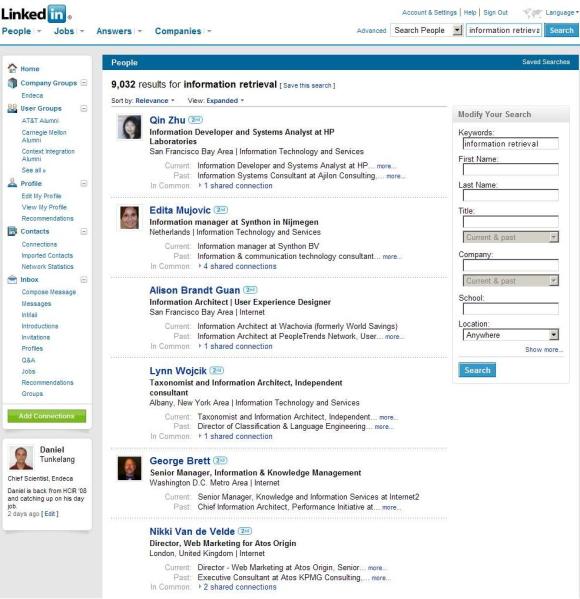
Today LinkedIn officially anounced the launch of its new search platform. It’s slick, and it’s certainly an incremental improvement on their previous search functionality. But I still think they would benefit tremendously from faceted search, or from any approaches that enable exploration of large result sets, such as this one:

Categories
Uncategorized

CIKM ’08 Attendees: Please Blog!

I see that Greg and Iadh are attending CIKM 2008, and I hope they’ll find the time to blog about it. I’m particularly curious to hear any reports from the Workshop on Search in Social Media.

p.s. If anyone knows who mantains the CIKM site, please inform them that it’s been hacked. I tried to report this a while ago, but to no avail.

Categories
Uncategorized

Can Computers Help Humans Communicate?

Just saw this piece in the New York Times: “You May Soon Know if You’re Hogging the Discussion“. A quick excerpt:

The inventor of this technology is Alex Pentland of the Massachusetts Institute of Technology, who has developed cellphone-like gadgets to listen to people as they chat, and computer programs that sift through these conversational cadences, studying communication signals that lie beneath the words.

If commercialized, such tools could help users better handle many subtleties of face-to-face and group interactions — or at least stop hogging the show at committee meetings.

As an MIT alum, I appreciate the aspiration to improve interpersonal communication skills. I’m a bit skeptical of such a reductionist approach, but perhaps it’s no more mechanical than what passes for active listening.

Categories
Uncategorized

Google Loves The Noisy Channel

Well, I suppose it can’t be personal (or so they claim), but at long last this blog has achieved something I never thought possible–it’s achieved a higher ranking than Shannon on a Google search for noisy channel.

And even Google Suggest seems to be showing some love:

Noisy chickens? Well, my thanks go out to all of the pigeons at Google who have been conspiring to bring on the noise here at The Noisy Channel.

Categories
Uncategorized

Blogs I Read: Daniel Lemire’s Blog

Ever since I started blogging, I’ve wondered why academics don’t embrace blogs and other social media. In fact, I just blogged about it earlier today. But a great example of an academic who gets blogging is Daniel Lemire.

Daniel has been blogging since May 2004. He is a professor of computer science at the Université du Québec à Montréal (yes, he also has a French-language blogue). Perhaps it is to be expected that he has made the most of online media, as he teaches almost exclusively online, in areas that include information retrieval and data mining. He’s also spent some time outside the ivory tower; his industry accomplishments include the design of signal processing and recommendation systems.

Daniel’s blog doesn’t have a mission statement, but he is at his best–and most passionate–when presenting his perspective on computer science research. He cites these as some of his best posts:

As should also be clear from these titles, Daniel has personality. He doesn’t pull punches, and his candor and passion make for great reading. Moreover, his openness brings out the same in his commenters, which ensures that his more controversial posts become engaging discussion forums.

One quirk of his blog: in order to post, you have to pass a CAPTCHA that requires answering a Roman numeral arithmetic question. He soon discovered, however, that the Google calculator happily performs this task. He posted about it:

I can’t help but imagine the discussion between between the Google engineer and his boss:

  • (Engineer) Hi boss! I plan a new feature for our search engine…roman numeral arithmetic!
  • (Harvard MBA) What a great idea! (Thinking to himself: I need to replace this guy.)

Check out Daniel Lemire’s blog for yourselves. And, if you are an academic, check out his thoughts on academic blogging.

Categories
Uncategorized

Why Grad Students Should Blog

I just read a nice piece in the New York Times entitled “If No One Sees It, Is It an Invention?“. The gist: then CMU PhD candidate Johnny Chung Lee drew over six million views to a five-minute video he posted on YouTube showing how to use a Wii remote to transform a normal video screen into a virtual reality display. Correlation isn’t causality, but I think it’s not entirely coincidental that Lee received “lots of offers from all the big places” and ultimately took one in the applied sciences group of Microsoft’s entertainment and devices division.

Granted, producing YouTube videos isn’t exactly the same as blogging, but the moral of the story is summed up in these two paragraphs:

Contrast this with what might have followed from other options Mr. Lee considered for communicating his ideas. He might have published a paper that only a few dozen specialists would have read. A talk at a conference would have brought a slightly larger audience. In either case, it would have taken months for his ideas to reach others.

Small wonder, then, that he maintains that posting to YouTube has been an essential part of his success as an inventor. “Sharing an idea the right way is just as important as doing the work itself,” he says. “If you create something but nobody knows, it’s as if it never happened.”

Grad students–and other inventors–should learn from this story that communicating your ideas to a broad audience can be a huge success factor. Blogging and posting to YouTube aren’t the same as publishing in peer-reviewed venues, but they can be as or more important in advancing your professional career.