Categories
Uncategorized

The Taxonomy Folksonomy Cookbook

cookbook1

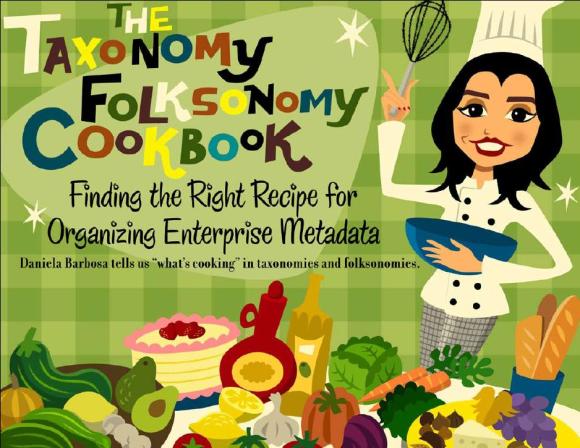
Check out Daniela Barbosa‘s beautiful (and free!) ebook, Taxonomy Folksonomy Cookbook! She introduces the subjects of taxonomies and folksonomies, and encourages you to use both in your recipes. It does include a pitch for Dow Jones, Daniela’s employer, but it’s low key. Regular readers know that I’m no fan of advertorials, and I’ll vouch for the legitimacy of the content.

Via Ron Miller.

Categories
Uncategorized

IEEE Computer Special Issue on Information Seeking Support Systems

Check this this month’s issue of IEEE Computer, which offers a special issue on Information Seeking Support Systems. You can read the editors’ introduction (the editors are Gary Marchionini and Ryen White) for free here. I can’t find the rest of the special issue online yet, but I’ll let you know when I do. If anyone here has more details, please let the rest of us know!

Categories
Uncategorized

A Sound Approach to Exploratory Music Search?

I just noticed an article today in CNET, “Mufin Player organizes songs by sound“, that describes mufin:

mufin’s music recommendations are based on the sound of the music itself. Only the similarity in sound decides whether a track is recommended or not.

Check it out–you don’t need to download any player in order to explore the 5M+ songs they’ve already indexed. I found the recommendations to be a bit erratic,  but I’m intrigued by the concept, especially after being underwhelmed by Apple’s Genius recommendation engine. So far my preferred music exploration tool is Pandora, about which my only complaint is its limited repertoire.

I know we have music information retrieval experts in the house, and I’m sure we have lots of music consumers. I’m curious to hear what folks think of mufin. Tempting but half-baked?

Categories
Uncategorized

Who Says I’m An Authority?

Every now and then I try to sneak in a self-indulgent post, and this happens to be such post. I decided to look at Technorati to see how they measured the authority of The Noisy Channel, as well as the basis for that measurement.

As of this writing, The Noisy Channel has an authority of 65, which makes it the 80,964th most authoritative blog indexed by Technorati. Not sure if that’s good or bad–I’m way behind Perez Hilton!

But I do owe what little authority I have to the 65 blogs that have linked to me in the past 180 days. Here are my ten most authoritative bestowers of Technorati authority:

While I’m not sure how much to read into these numbers, I do appreciate the link love.  Traffic to The Noisy Channel has steadily increased over the past months, and I know I owe that in large part to reader evangelism–through links from other blog, Twitter, and perhaps even good old-fashioned word-of-mouth.

So, to all of you, and by the authority you all have invested in me, thanks! This noise is for you.

Categories
Uncategorized

Users Will Pay For Content–And Not Just iTunes

Saul Hansell writes in his post “Why Are iPhone Users Willing to Pay for Content?“:

What’s most interesting is how iPhone users are willing to spend money in ways that Web users are not.

I’ve criticized Apple from time to time for not having a coherent approach to delivering free content with advertising. But in some ways, the development of a market for paid content is a bigger and less expected achievement.

I’ve had my sanity questioned for believing that there’s life beyond ad-supported content. In fairness, Apple has learned that it’s got to sell content cheaply, whether it’s $0.99 for a song or $4.99 for an ebook. But cheap is a lot better than free, and it gives authors / content providers a model that is not beholden to advertisers.

So, the next time someone mocks my opposition to the ad-supported model, my battle cry will be “What Would Apple Do?”,

Categories
Uncategorized

How Recommendation Engines Quash Diversity

As regular readers here know, I have strong opinions about how recommendation engines should work. So does Daniel Lemire, a regular reader who specifically argues in favor of diversity in recommender systems. Well, this post is for him and all who share his concern.

In “Does Everything Really Sound Like Coldplay?“, Vegard Sandvold explains:

When a lot of people (who may otherwise have very diverse tastes in music) listen to Coldplay, Coldplay becomes very well connected with a lot of other artists, and also becomes a hub in what is known as a small-world network. Such networks are the basis for social recommendations. Oscar shows that these hubs are indeed the most popular artists, who again gets recommended more often than others. That is why all roads lead to Radiohead.

The cited Oscar is Oscar Celma, who recently defended his PhD thesis on “Music Recommendation and Discovery In The Long Tail”. I’ve only had a chance to skim the abstract, but I’m optimistic that people are giving more thought to the limitations of current recommendation systems. Of course, I’d really like it if they embraced transparency and exploration. But emphasizing diversity is certainly a worthy endeavor.

Or maybe everything really does sound like Coldplay…

Categories
Uncategorized

Information Wants to be Expensive

Former Wall Street Journal publisher and executive vice-president of Dow Jones L. Gordon Crovitz writes:

When author Stewart Brand coined the expression “Information wants to be free,” he focused on how technology makes it cheap and easy to communicate and share knowledge. But the rest of his quote is rarely noticed. This says, “Information also wants to be expensive.”

Read more in his Wall Street Journal opinion piece, entitled “Information Wants to be Expensive“.

Categories
Uncategorized

Jeremy Blogged in Class Today!

OK, for those of you who don’t recognize the Pearl Jam allusion, here are the lyrics and video. But most of all, congrats to Jeremy Pickens for jumping in to the blogosphere with his new blog: Information Retrieval Gupf.

Most readers here who read the comments (note to RSS readers–you can and should also read the comments feed via RSS!) know Jeremy as Google’s outsourced conscience. So it’s not surprising to see him blogging about Google’s attitude towards competition in his most recent post, entitled “One Click Away“.

I’ve of course added Jeremy’s blog to the feeds I read. While I realize he’ll now be splitting his time between commenting at The Noisy Channel and posting to his own blog, I’d like to think that I’m not losing a commenter but gaining a blogger. Jeremy, welcome to the dark side!

Categories
Uncategorized

Quasi-Property Rights: Associated Press and the “Hot News” Doctrine

Like many bloggers, I learn which topics are “hot” from aggregators like Techmeme–which in turn automatically aggregate news sources from around the world (though lately they’re also receiving help from human volunteers). I’ve always thought this fell under the doctrine of fair use.

But apparently neither the Associated Press nor the courts think so. As Joe Mullin reports at The Prior Art:

A New York federal judge ruled Tuesday that The Associated Press can sue its competitors not merely for copyright infringement, but for a “quasi property” right in the news known as the “hot news” doctrine.

As Mullin points out, this doctrine seems broad enough to cover any instance where one news organization covers a topic after being “scooped” by a competitor. Surely no one would dream of applying it so broadly, but stranger things have been known to happen.

Intellectual property law is crazy enough without entertaining a world where me-too coverage–or even mere citation–is considered theft. I hope that this lawsuit established a sustainable standard of fair use. I shudder to think that Techmeme could sue me for writing this post–if Mullin didn’t sue both of us first!

Categories
Uncategorized

Relevance is Not a Game Changer in Search

The top story on Techmeme as I write is Randall Stross ‘s New York Times article, “Everyone Loves Google, Until It’s Too Big“. As Stephen Arnold notes, don’t read the article expecting to learn something new. Still, not everyone who reads the New York Times is current on the search industry, and the article does sum of the state of affairs neatly.

In particular, there’s a nice point by Prabhakar Raghavan, head of Yahoo! Research:

“Whether we’re slightly ahead or slightly behind Google in core relevance is not a game changer in search,” said Prabhakar Raghavan, Yahoo’s chief search strategist.

Yahoo’s best opportunity, Mr. Raghavan said, is to offer radically new ways of presenting information that will help users finish whatever it is they started before the search, like finding a job or buying a plane ticket. “People don’t want to search; it’s a digression,” he said. “They want to complete a task.”

Yes, I told you so. And so did Prabhakar, among others. I just wonder how long it will take for the rest of the world to figure this out. That’s why I’m happy to see this discussion making it into the paper of record.